


Saint of the Week: Élie Naud
9/10/2025
Élie Naud
1662 - 1722
Catechist and Teacher
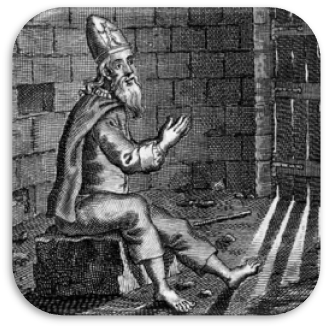
Élie Naud, or Elias Nead, born in Moëze, Saintonge, was a French Huguenot. When the Edict of Nantes was revoked in 1685, he fled first to Saint-Domingue and then to Boston, where he prospered as a merchant. In 1692, he was captured by a French privateer near Jamaica. As a “fugitive French Protestant,” he was initially sentenced to life as a galley slave. Imprisoned in Marseille Castle’s dungeon for two years and then confined to the Château d'If off Marseilles’ coast for 50 days, he was freed in 1697, only after King William III affirmed that Naud was actually an English subject. Back in North America, his story made him “the most famous refugee in British America at the time." His refusal to gain freedom by converting to Catholicism attracted "a wide Protestant readership in both French and English.“ In 1704, Naud cut his ties with the Huguenot church and converted to Anglicanism. The Society for Propagation of the Gospel then appointed him as a minister to black slaves in North America. He established the first school for African-Americans in New York City and in 1706, secured passage of a New York bill allowing enslaved persons to be catechized. His task was difficult, but his work as a “zealous and prudent servant of Christ, in proselyting…[enslaved and native Americans]…to the Christian Religion” prompted the Society to put a bill through Parliament “for the effectual Conversion of…Servants in the Plantations, to compel Owners of Slaves to [allow them] to be instructed in the Christian Religion.” Naud’s school suffered in 1712 when rumors spread that his instruction caused “the Negro riot” in that city. Eventually it surfaced that only one of his students had been involved--the most criminal elements actually belonged to masters who openly opposed educating them. Not only was Naud allowed to continue, but the Governor, the Chief Justice, New York City’s Mayor, and City Council informed the Society that Naud performed his work “to the great advancement of religion in general and the particular benefit of free Indians, Negro slaves, and other Heathens in those parts, with indefatigable zeal and application.” He is buried in the churchyard of Trinity, Wall Street.


