


Saint of the Week: W. E. B. Dubois
8/6/2025
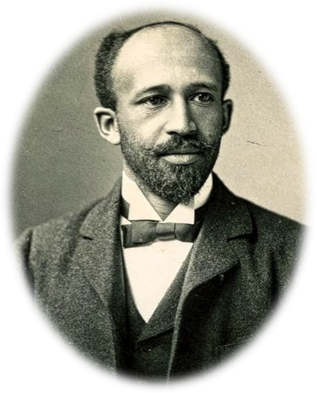
W. E. B. DuBois
1868 - 1963
Activist and Social Reformer
William Edward Burghardt DuBois was an American civil rights activist, Pan-Africanist, sociologist, historian, author, and editor. Historian David Levering Lewis wrote, "In the course of his long, turbulent career, W. E. B. DuBois tried virtually every possible solution to the problem of 20th century racism— scholarship, propaganda, integration, national self-determination, human rights, cultural and economic separatism, politics, international communism, expatriation, third world solidarity.“ The first African-American graduate of Harvard University, he earned his Ph.D. in History and became a professor of history and economics at Atlanta University. Elected to lead the National Association for the Advancement of Colored People (NAACP) in 1910, he also founded and edited its journal, The Crisis. He grabbed national attention by opposing Booker T. Washington's ideas on social integration between whites and blacks, campaigning instead for increased political representation for blacks that guaranteed civil rights, and by forming a Black elite that would work for the progress of the African American race. W. E. B. Du Bois was involved in religion, studied Baptist churches, and contributed to the sociological study of religion. He argued that church “introduces the stranger to the community, it serves as a lyceum, library, and lecture bureau—it is, in fine, the central organ of the organized life of the American Negro.” Susan Jacoby writes that DuBois was "raised as a liberal New England Congregationalist ...contrary to the majority of blacks, who were brought up in the Baptist evangelical tradition." Du Bois' polemical stance on prayer in school and his critical views on the church also kept him at odds with contemporary Booker T. Washington. DuBois wrote many books, including three autobiographies. Among his most significant works are The Philadelphia Negro (1899), The Souls of Black Folk (1903), John Brown (1909), Black Reconstruction (1935), and Black Folk, Then and Now (1939). His book The Negro (1915) influenced the work of several pioneer Africanist scholars. Historians John Parker and Richard Rathbone call the book the "first serious attempt at a continent-wide history [of Africa]."


